Tip! When creating your order, choose a project name with recognition value for your budget!
**Special features**: - **Orders** with partial payments or recurring payments are divided into the months of invoicing in the budget to provide a more realistic overview of the current status of the budget. - **Provisions** for special payments are approximate calculations based on the salary categories, which help to calculate the necessary amount for June, November and the end of the employment on a monthly basis. More on the calculation of special payments via the guide. - **Budget transfers** cannot be opened after they have been released, so it is also advisable to name them with recognition value. ##### **Lines in the budget** **Orders** Orders **with a payment guarantee** appear in both the planned and the available budget. If an order has been paid, the incoming payment appears under Payment. Orders **without a payment guarantee** appear in the planned budget, but are not in the available budget. The amount is only available after invoicing and receipt of payment. **Employment costs** The employment costs are initially entered in your budget in the "**Planned**" and "**Available**" columns as outgoing payments for the duration of your employment in accordance with the total costs from the employment category, and are updated after the monthly payroll run with the exact amount actually settled in the Payment column from payroll accounting. Subcategories of employment and travel expenses do not receive their own amount when paid. The total appears in the line for employment. Subcategories of employment are: - Special payment provision - Special payment **Reimbursement of expenses and direct payment** If your reimbursement of expenses or direct payment to third parties has been confirmed by Smart, it will appear in the budget in the month in which it was confirmed. The expenses are deducted net from the budget , you **receive the gross amount (incl. VAT) in your account. This means that the input tax refund is no longer a separate line in the budget.** **RK - Travel expenses** Travel expenses that you request in the Smart Portal are paid out with your salary and appear in the portal as a payment under your employment costs in the respective month. You will find the travel expense receipt in the expense reimbursement section and the payment details on your payslip. **Budget transfer - Outgoing** If you work with other Smart members to whom you send budget, you will find these outgoing payments as "Budget transfer" in the monthly overview. For you, such an outgoing payment is free of charge and VAT. The receipt of the budget transfer is also VAT-free for the other person and no additional Smart fee is charged. **Budget transfer - Incoming** If you work with other Smart members who send you a sum from their budget, you will find these incoming transfers as budget transfers in the monthly overview. An incoming budget transfer is free of charge for you, there is no Smart fee or sales tax. ##### **Columns in the budget** **"Planned budget"** Total of all planned confirmed orders and employment costs. **"Available budget"** All orders with payment guarantee and paid orders without payment guarantee, employment costs, confirmed expenses. **"Payment balance"** All actual incoming and outgoing payments on the Smart Bank account that have been allocated to your budget. # Collective budget ##### General information Collective budgets are intended for groups that work together. For the sake of simplicity, we ask collectives to select a budget manager. More info below. **Employment is not possible via collective budgets**, but it is possible to make budget transfers to the personal budgets of the members of the collective and create employment there.Please note that at Smart all users have equal rights and even if you carry out orders for each other, all users manage their own personal budgets, which others have no insight into.
##### Add collective budget Go to Budgets and + New collective budget Select a name for the collective budget in the form and whether the budget should be created in SMartAt e. Gen. or smart@work GmbH. If you have any questions, the smart team will be happy to help.A collective budget must have at least one member in addition to you in order to be created. To select additional users, you need the user number in the format AT-U{four-digit number}, e.g. AT-U0001. Please clarify your joint project with the other users before creating the budget.
You can then **check** whether you have entered the correct person and add them. You can add further budget members now, or do so at a later date. To complete the process, click on "Create budget".The newly added Bugdet members will receive an e-mail with a **confirmation link**. As soon as a member has confirmed the link, the new budget is created.
##### Create orders As soon as a member has confirmed the collective budget, you can create your first orders. Simply select the collective budget in the order form under Budget. ##### Roles in the collective budget: A collective budget has **1 budget manager** and 1 or more members. The budget manager can manage members, create orders, submit expenses and add budget transfers. The members can view the budget but cannot manage it. The roles can be managed in the portal by the budget manager. ##### Manage members of the collective: Click on the budget and open the list of members. Here you can add and delete members and change the budget manager. ##### Change budget manager As a budget manager, you can select another member of the collective as budget manager at any time. The new budget manager will receive an email to confirm this.Only 1 member can have the role of **budget manager** in the collective.
After confirmation, a notification appears. # Budget transfers Budget transfers are managed via the budget overview of the budget from which the transfer originates as an expense. The "**New budget transfer**" button is located at the top right. This opens a window. It is important that you enter the recipient budget number in the format AT-A{budget number}, e.g. AT-A33. The name of the transfer appears in both budgets, so it should be clear what it is about. [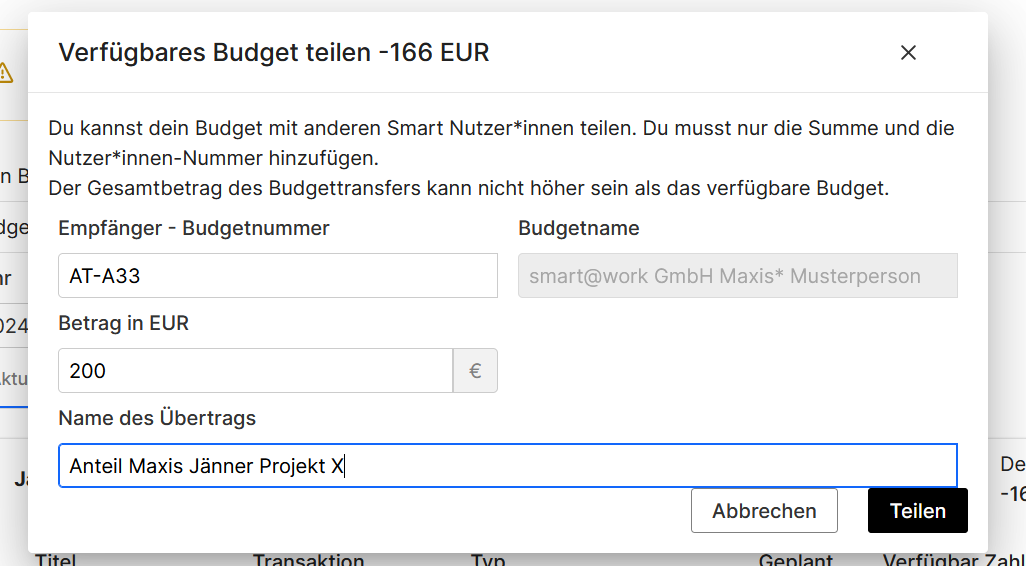](https://guide.smartat.coop/en/uploads/images/gallery/2024-08/smartcoop-budget-transfer.png)Budget transfers are subject to **approval** by Smart, and recipients are informed of the transfers by email.